Distributed Context Architecture: How I Scale Claude Code in Complex Environments
Claude Code Context Management Beyond a Single Repository

I’ve been seeing a lot of tutorials showing how to set up Claude Code with a single claude.md file in the project root. For those building simple apps, this works perfectly. But in my daily routine dealing with multiple business domains, integrations, and complex architectures, this monolithic approach breaks down fast.
When you cram frontend guidelines, data pipelines, and infrastructure rules into one place, the model suffers from what we call “context rot.” The agent passively injects useless rules at startup, the context window saturates quickly, and reasoning degrades. The result? You burn a massive amount of tokens (and money) before the AI even generates its first line of useful code.
To solve this, I structured my machine using a distributed memory topology. The goal isn’t to provide the agent with the maximum amount of context, but rather the exact context on demand.
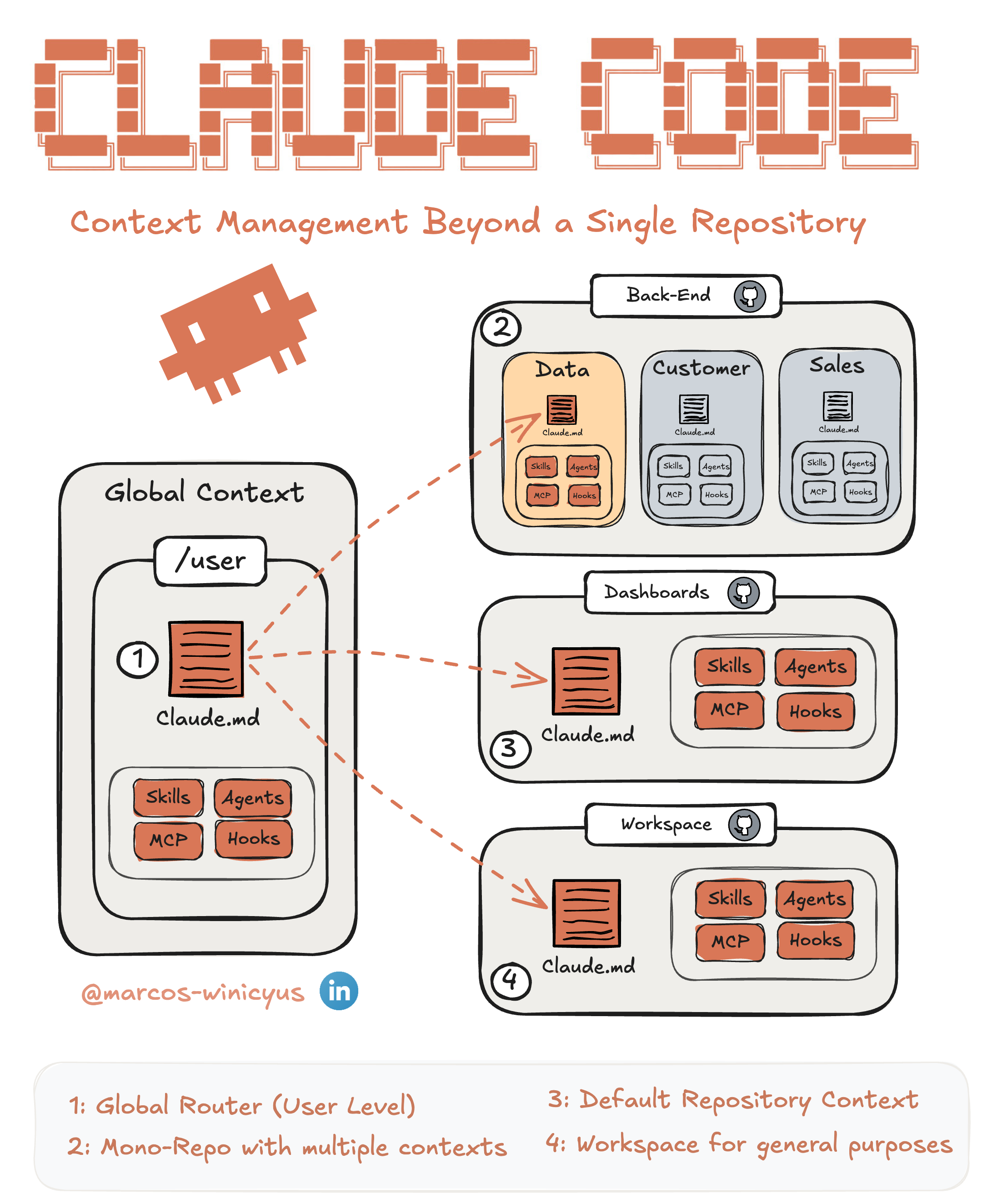
Here is the technical breakdown of how I divide this ecosystem:
1. The Global Router (User Level)
The setup starts at the operating system level (user root directory), where Claude Code is installed. I don’t write any software engineering rules here. This global claude.md acts strictly as a semantic router. It defines my macro goals and contains only pointers to local repositories. This gives the agent immediate situational awareness (a “map” of where it is) at an almost zero token cost.
2. Standard Repositories
For microservices or projects with centralized goals, the structure follows the community standard (folders for skills, docs, hooks, and agents). Since the domain definitions and frameworks are homogeneous, the context is hermetic and focused solely on that specific deliverable.
3. Monorepos and Dynamic Scope
Here the approach changes drastically. A monorepo houses multiple teams, varied business contexts, and different tech stacks. Sharing a single global context inside it causes the model to hallucinate. The technical solution is to use path-based rules. I configure the system so that the guidelines for a specific area are only injected into the active prompt when the agent actually navigates or modifies files in that specific directory. It’s on-demand memory injection (context lazy loading).
4. Dedicated Workspaces (Analytical Decoupling)
This has been my biggest game-changer for ad-hoc and investigative tasks. Many activities don’t belong to a specific software repository—such as reading deep architectural documentation, generating complex reports, or consuming data via MCP (Model Context Protocol) servers.
I allocate these tasks to dedicated repositories serving purely as Workspaces. This prevents a severe issue called “Tool Bloat.” The agent doesn’t need to load entire database schemas and heavy connections into memory while I’m just trying to change a button’s style in another project. Isolation maintains agility.
The Impact on Engineering and Governance
Mathematically, this structural division has cut the startup token consumption of my sessions by about 60%. The agent initializes faster, inference latency drops, and response quality remains high throughout long conversations.
But the most profound impact happens in corporate governance. By decentralizing memory into the repositories, Code Review evolves. We no longer just review source code; we actively review the AI artifacts committed alongside the project. Evaluating how a skill or a context hook was written becomes just as critical as validating the application’s logic itself.
Scaling code agents isn’t about having models with infinite context windows, but having the architectural discipline to orchestrate the right information at the exact right moment.